
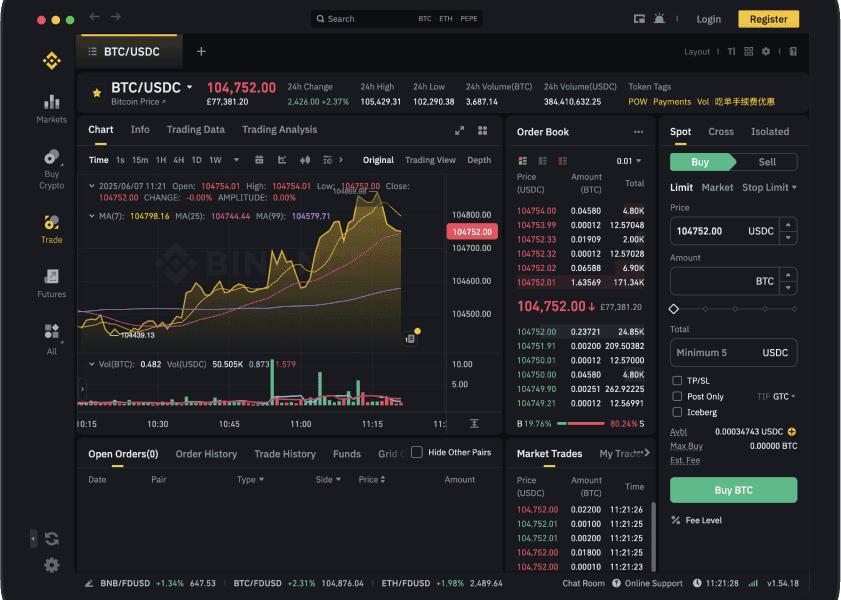

Binance, as one of the world’s leading cryptocurrency exchanges, has established a robust and highly scalable trading system that supports millions of users globally. The ability to handle vast amounts of transactions seamlessly is crucial in the fast-paced environment of digital asset trading. Binance’s trading systems incorporate several technological innovations and architectural strategies designed specifically to support scalability while maintaining high performance, security, and reliability.
At the core of Binance’s scalability is its distributed architecture. Unlike traditional centralized systems that can become bottlenecks under heavy loads, Binance employs a microservices-based approach. This design breaks down the entire exchange platform into smaller, independent services that communicate through APIs. Each service handles specific functions such as order matching, user authentication, or market data streaming. By decoupling these components, Binance can scale individual parts independently based on demand without affecting the overall system stability.
Another critical element supporting scalability is Binance’s use of advanced load balancing techniques combined with cloud infrastructure capabilities. Load balancers distribute incoming traffic evenly across multiple servers to prevent any single node from becoming overwhelmed. This ensures consistent response times even during peak trading periods when transaction volumes spike dramatically due to market volatility or major announcements.
The matching engine-a broader perspective fundamental component responsible for pairing buy and sell orders-is optimized for ultra-low latency processing at massive scales. Binance’s proprietary matching engine utilizes efficient algorithms written in low-level programming languages like C++ to maximize speed and throughput. It can process hundreds of thousands of orders per second with minimal delay, enabling traders to execute trades quickly and reliably.
To further enhance scalability and resilience, Binance leverages horizontal scaling by adding more servers rather than relying solely on vertical upgrades (such as increasing CPU power). Horizontal scaling allows the platform to expand capacity dynamically in response to increased user activity without downtime or degradation in service quality.
Data storage also plays an essential role in ensuring scalable operations on Binance. The platform uses distributed databases capable of handling high read/write loads while maintaining data consistency across multiple nodes worldwide. Additionally, real-time data caching mechanisms reduce latency by storing frequently accessed information closer to end-users.
Security measures are integrated throughout the system architecture without compromising performance or scalability. Techniques such as rate limiting prevent abuse during peak times while encryption protocols protect sensitive information transmitted between clients and servers.
In summary, Binance’s trading systems support scalability through a combination of distributed microservices architecture, sophisticated load balancing strategies, an ultra-fast matching engine optimized for low latency execution, horizontal server scaling methods, advanced data management solutions including distributed databases and caching layers-all reinforced by stringent security practices-ensuring a seamless experience for millions of users engaging simultaneously across global markets.